
The Supreme Court on Thursday held that the Governor can reserve a bill for consideration of the President even in the second instance, when the bill is again sent by the state assembly to him whether in its amended or unamended form.

The Supreme Court on Thursday refused to accept the preliminary objections raised by opposition-ruled states like Tamil Nadu, West Bengal and Kerala to maintainability of Presidential Reference, saying the issues raised in it pertain to the very core and foundational modalities of the constitutional machinery.
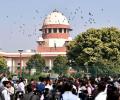
The Supreme Court has begun hearing petitions challenging the Election Commission's decision to conduct a special intensive revision exercise in Bihar ahead of elections, raising concerns about voter exclusion.

The Supreme Court on Friday said no one blamed the chief pilot of the Air India Dreamliner for the June 12 crash, which claimed 260 lives, and asked his 91-year-old father not to carry any emotional burden.

A bench of Justices Surya Kant and N Kotiswar Singh was acting on a batch of pleas against the blanket ban on blood donations by such persons from the LGBTQIA+ community.

The Supreme Court has taken serious note of the digital arrest of a senior citizen couple in Haryana based on forged orders, highlighting the rising number of such cases and seeking responses from the Centre and CBI.

The Supreme Court of India has ruled that a governor has discretion under Article 200 to refer a state bill to the President or return it to the legislature, and is not bound by the advice of the council of ministers. The court clarified that a governor cannot simply withhold a bill.

The Supreme Court on Thursday refused to examine a public interest litigation (PIL) seeking a judicial probe into the April 22 Pahalgam terror attack in which 26 people were killed.
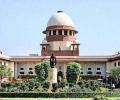
The Supreme Court of India has scheduled a hearing on February 19 for pleas challenging the appointment of the Chief Election Commissioner and Election Commissioners under the 2023 law. The court emphasized the potential consequences if any action is taken before the hearing. The pleas argue that the 2023 law, which excludes the Chief Justice of India from the selection panel, undermines the independence of the Election Commission and allows for undue influence from the executive branch. The court's earlier verdict in March 2023 called for an independent selection panel comprising the Prime Minister, Leader of the Opposition, and the Chief Justice of India to ensure the integrity of the Election Commission. The case highlights concerns about the independence of India's electoral process and the potential for political influence in the appointment of key election officials.
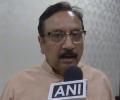
A bench of Justices Surya Kant and N Kotiswar Singh deferred the hearing on Shah's plea after his counsel and senior advocate Maninder Singh made a request.
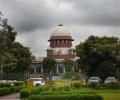
The Supreme Court intervened to ensure a tragedy-struck widow received compensation from the Railways after a 20-year legal battle following her husband's death in a train accident.
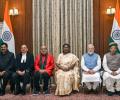
The Supreme Court's opinion on the presidential reference can impact on any number of cases if and when governors, if not the President, take a literary view of the Supreme Court's 'ppinion' on their 'discretionary powers' without reference to the rider on 'reasonable time', points out N Sathiya Moorthy.
The Supreme Court expressed deep regret that the actual perpetrator of the Nithari killings was not established despite a prolonged investigation, while acquitting Surendra Koli in the last Nithari murder case.

The Supreme Court has directed the Election Commission to address typographical errors and other mistakes in the final Bihar electoral roll. The court will hear further arguments on November 4.
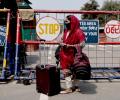
The Supreme Court on Friday directed authorities not to deport to Pakistan six members of a family, who allegedly overstayed their visa, till their citizenship claim is verified.

Ashoka University professor Ali Khan Mahmudabad, previously booked for social media posts, has petitioned the Supreme Court for the release of his passport, a condition of his bail. The court will consider the plea on November 18.
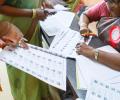
The Supreme Court declined to entertain a plea seeking a special investigation team (SIT) probe into alleged electoral roll manipulation in Bengaluru Central and other constituencies, advising the petitioner to approach the Election Commission of India.
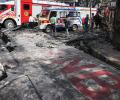
The Supreme Court has raised concerns about the preliminary report on the Air India crash and has asked for a more independent and thorough investigation.
The Election Commission of India clarified that claims, objections, and corrections to the draft electoral roll in Bihar's special intensive revision exercise can be filed beyond September 1, but will be considered after the roll is finalized. The Supreme Court directed assistance for voters and parties in filing claims.
The Supreme Court of India resolved a decades-old land dispute in the Union Territory of Dadra and Nagar Haveli, involving land originally vested in the Portuguese government.

The Supreme Court of India has ruled that individuals affiliated with political parties are not barred from contesting elections for bar bodies. The court dismissed a PIL seeking directions to prevent such candidates, arguing that a diverse range of ideologies is essential in a democracy and that there is no law prohibiting politically active individuals from participating in bar body elections.
The Election Commission defended its Special Intensive Revision (SIR) exercise for Bihar's voter list in the Supreme Court, calling it accurate and dismissing allegations of impropriety by political parties and NGOs.

The SC questioned the language used by Allahbadia during the show, saying society has some values.

The Centre has argued before the Supreme Court that state governments cannot use writ jurisdiction to challenge the actions of the President and Governor regarding bills passed by state assemblies, particularly concerning fundamental rights violations. The President seeks the Supreme Court's opinion on whether states can file writ petitions under Article 32 and the scope of Article 361.

Kejriwal, who was arrested on March 21 by the Enforcement Directorate (ED) in the same case and later by the CBI which was probing corruption charges, stepped out after spending 155 days in Tihar jail. The AAP supremo, who was earlier granted three-week interim bail in the ED case, was given a resounding welcome by his party leaders and supporters who were drenched in heavy rain. Addressing party workers from the top of an SUV, Kejriwal, sporting a half-sleeve blue shirt, raised 'Inquilab Zindabad' and 'Vande Mataram' slogans.
The Supreme Court has granted protection from arrest to The Wire's founding editor Siddharth Varadarajan and Consulting Editor Karan Thapar in connection with an FIR registered by Assam Police over a news article.
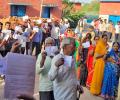
The Supreme Court has directed the Election Commission to include Aadhaar as a valid document for voter identification in Bihar's special intensive revision of electoral rolls, clarifying it is not proof of citizenship.
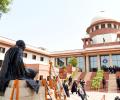
Calling itself the "custodian of the Constitution", the Supreme Court on Thursday asked if it could "sit idle" if a constitutional functionary like governor failed to discharge duties, as it reserved its verdict on the presidential reference on grant of assent to bills.
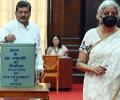
An overview of the past vice presidential elections in India, highlighting uncontested wins, multi-cornered fights, and notable candidates.
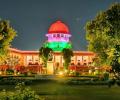
The Centre told the Supreme Court that governors are not indefinitely sitting on bills passed by state legislatures, and that barring a few exceptions, most have acted in a way which the apex court would have perhaps desired. Solicitor General Tushar Mehta argued that a Governor is "not a rubber stamp" and has a duty to preserve, protect, and defend the Constitution.
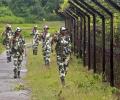
The Centre has denied any discrimination in granting permanent commission to Short Service Commission (SSC) women Army officers compared to their male counterparts, assuring the Supreme Court that all parameters are being duly followed.
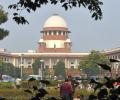
The Supreme Court has scheduled hearings starting August 19 for the Presidential Reference concerning constitutional issues related to timelines for handling bills passed by state assemblies. The court has directed the Centre and states to submit written arguments by August 12.
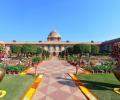
The Supreme Court has ruled that a Governor cannot send bills to the President for consideration if the state assembly has already cleared them for a second time. The court was questioning the Centre over the powers of the Governor when it comes to granting assent to bills.
The Supreme Court is scheduled to hear a batch of pleas challenging the Election Commission's decision to conduct a Special Intensive Revision (SIR) of electoral rolls in Bihar. Political parties and other petitioners have raised concerns about the revision process.
The Supreme Court declined to examine a plea challenging a PMLA provision, stating the issue lies in the law's abuse, not the law itself. The court allowed the petitioner to approach the High Court if procedures weren't followed.
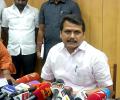
The Supreme Court has criticized the Tamil Nadu government for implicating over 2000 individuals in the cash-for-jobs scam involving former minister V Senthil Balaji, demanding details of all accused and witnesses.
The Supreme Court is hearing arguments regarding a presidential reference on whether fixed timelines can be imposed on governors and the president for acting on bills passed by state legislatures. The court is considering objections to the maintainability of the reference under Article 143 of the Constitution.

The Supreme Court of India dismissed a Public Interest Litigation (PIL) seeking safety measures for tourists in remote hilly areas of Jammu and Kashmir, criticizing the petitioner for seeking publicity without a genuine public cause. The PIL was filed in response to a terror attack in Pahalgam that killed 26 people, mostly tourists. The court stated that the petitioner had a history of filing similar PILs primarily for publicity.
A Constitution bench comprising Chief Justice B R Gavai and Justices Surya Kant, Vikram Nath, P S Narasimha and A S Chandurkar, would fix the timelines on July 29 and commence hearing on the presidential reference in mid-August.

A bench of Justices Surya Kant and Ujjal Bhuyan, however, said there can be no straitjacket formula which enumerates that every case concerning the consideration of bail should depend upon the filing of a charge sheet.
 © 2026 Rediff.com - Advertise with us - Disclaimer - Privacy Policy - Sitemap - Feedback - About us - Terms of use - Grievances